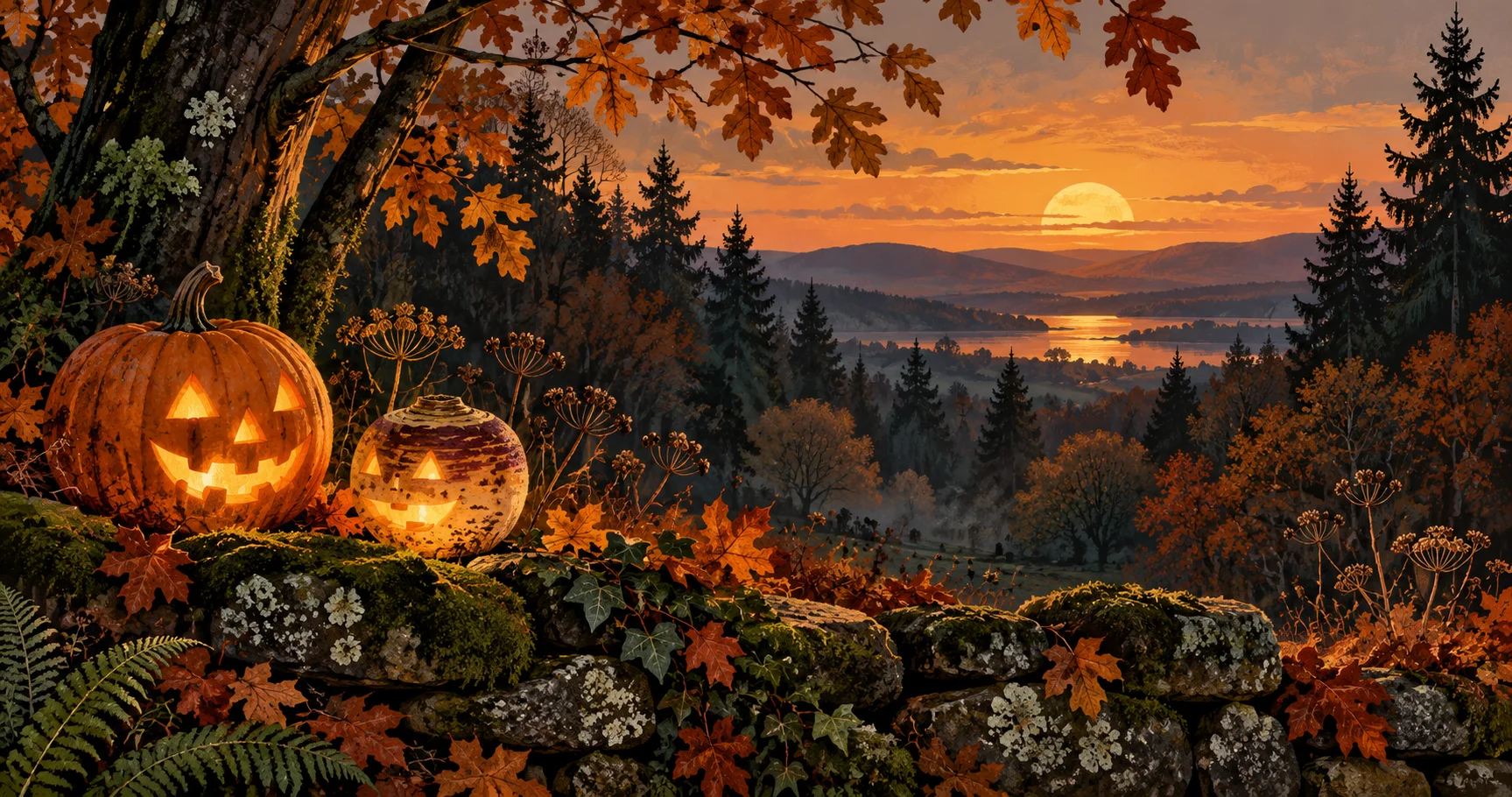
Samhain and Halloween have connected histories, but using the names interchangeably can hide the context a writer means. The National Museum of Ireland discusses them together in its account of Irish calendar customs. At the American Folklife Center, Stephen Winick also describes their relationship while questioning a familiar claim about the ancient Celtic year. The useful starting point is connection with context, rather than a claim that every celebration has always been identical. Read the museum account and Winick’s 2013 explanation.
What do the two names describe?
The museum places Samhain at the beginning of winter on 1 November and says much celebrating happened on the preceding evening. It explains Hallowe’en as the evening before All Saints, the “hallowed ones.” That account brings an Irish seasonal festival and a Christian calendar name into the same discussion. It does not require us to erase either context. For the festival’s date convention and its place in Wheel, continue to our Samhain introduction.
What does the museum actually record?
Its description includes disguises and visiting, alongside beliefs about returning souls and active spirits. These are descriptions of customs and beliefs in the museum’s Irish account. A statement that people expected spirits is evidence of a reported belief, not scientific evidence that spirits returned. Read the account as cultural material; it is not a universal set of instructions for celebrating today. Source: National Museum of Ireland.
Was Samhain definitely the ancient Celtic New Year?
That certainty deserves caution. In his 2013 American Folklife Center article, Winick discusses how scholarship had moved beyond an earlier Halloween brochure. He retains a relationship between Halloween and Samhain in Ireland, but questions whether Samhain began the Celtic year. His explanation considers the uncertain interpretation of ancient evidence rather than treating a repeated modern description as proof. Cite this as a qualified scholarly account, not a claim that the festivals are unrelated. Read the argument and its sources.
How can you compare them without oversimplifying?
Separate three questions: what a name means, what a particular source documents, and what someone chooses to observe now. Answering the first does not settle the other two. A seasonal interpretation, a family custom and a historical explanation need not compete, but each should be identified clearly.
This is the editorial approach used in this guide. It avoids turning one museum description into a rule for every community, or treating the oldest possible origin as the only reason something can matter. For the broader framework used by the app, read what the Wheel of the Year means. For a different seasonal context, see the Southern Hemisphere guide.
Does learning the history mean adopting a practice?
No. You can explore these sources for cultural or historical understanding without following a ritual. Personal meaning and historical evidence answer different questions. This comparison explains the distinction; it does not prescribe a celebration or provide a practice pack.
Keep exploring in Wheel
The free app includes festival introductions and sources, an interactive wheel and countdowns. Optional Premium adds full festival journeys, the 48-session Seasonal Path and planning resources. Those complete resources, personal choices and private records stay in the app. Your store shows current prices and any trial eligibility.
Explore Wheel on the App Store · Explore Wheel on Google Play
Sources reviewed 21 October 2026. Full practice, planning and Premium resources remain in-app.